SkillSync — AI-powered freelance matching platform
Designing a smarter way to connect freelancers and clients using AI-driven matching, proposal generation, and decision support. Better matches. Less effort. Lower risk.
View case study
Live prototype

Snapshot
The work at a glance
Product designer leading the full concept
Role
Product designer
View
Timeline
Three to four weeks of design work
View
Tools
ChatGPT, Stitch AI, and Figma
View
Type
AI marketplace SaaS platform
View
Origin
How a classroom exercise became real
This started as a business model canvas assignment. Most students treated it as theory. I asked a different question instead.
What if this became an actual product?
That question changed everything.
SkillSync was born from that curiosity.
Read
Next
Problem
Hiring is broken and noisy
Clients drown in irrelevant applications. Freelancers waste time writing identical proposals. Both sides lose.
Explore
Next

Feature Section
Solution breakdown: SkillSync as “Upwork + AI Recruiter” with bullet points on AI matching, proposal generation, pricing, and hiring acceleration.

Feature Section
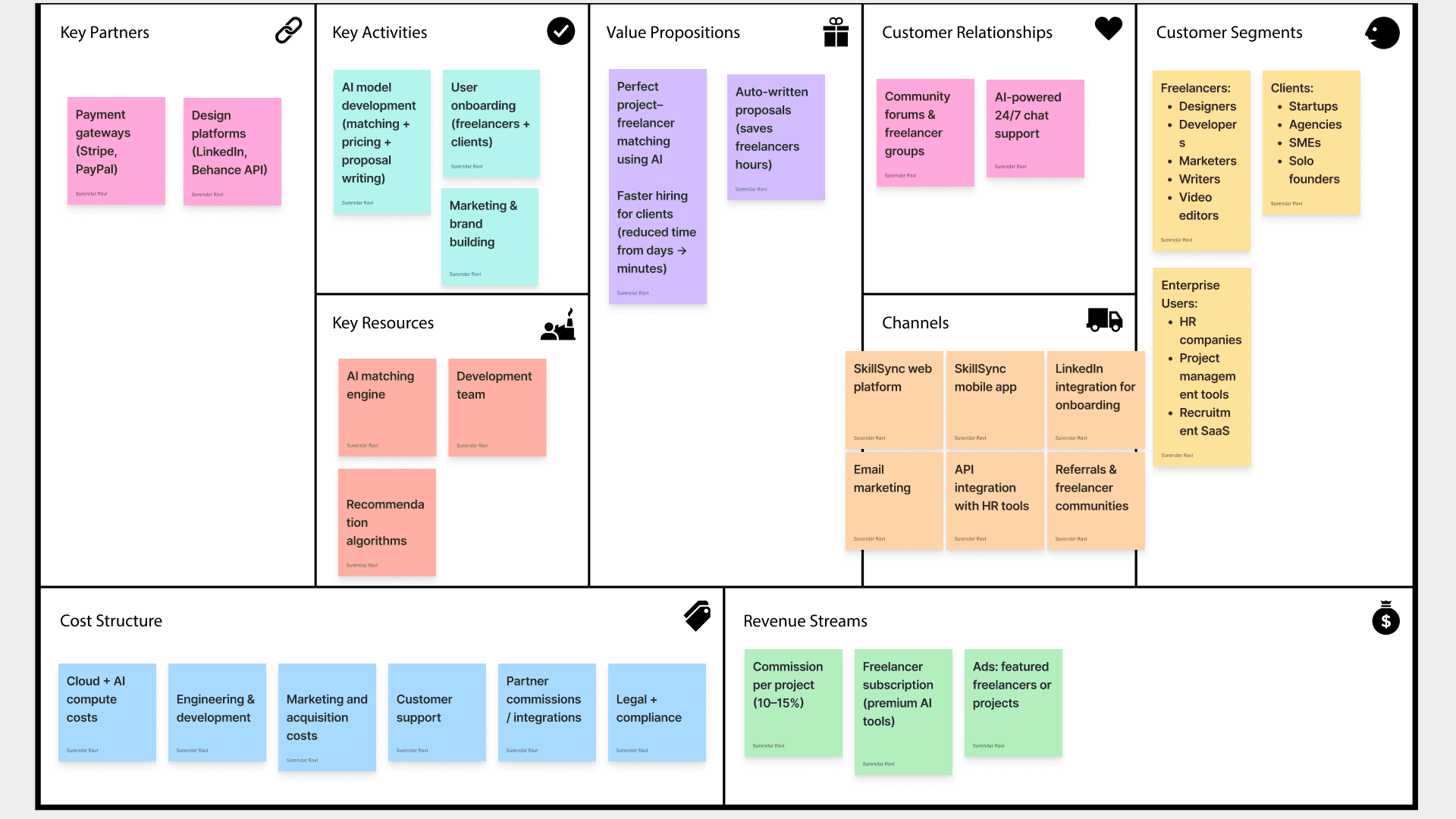
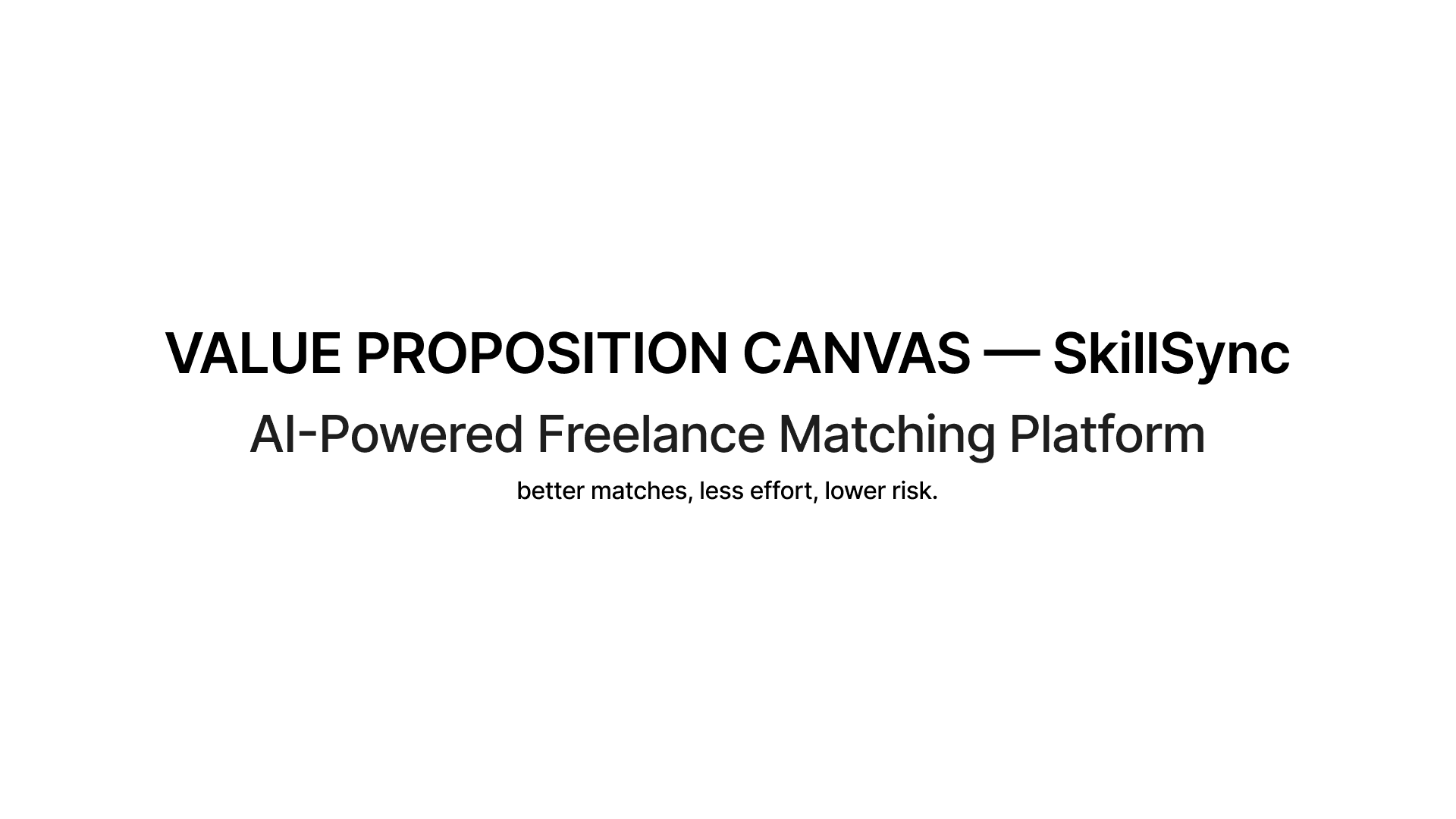
Business Thinking—visual Business Model Canvas and Value Proposition Canvas, with insights on platform model, revenue, and value creation.

Feature Section
Product Architecture—diagram or illustration of the 3-layer system: Input (profiles/jobs), AI (matching/proposals/pricing), Output (matches/decisions).
Features
What makes it work
Six tools built for speed and accuracy.
AI matching engine
Finds the best fit instantly.
View
Proposal generator
Writes pitches that actually convert.
View
Pricing suggestions
Sets rates that win without leaving money.
View
Smart dashboard
Shows what matters most at a glance.
View
Feature Section
User Flows for freelancers and clients, depicted with visual journey maps or step-by-step diagrams.
Feature Section
AI Layer—explaining how AI is embedded throughout the product, emphasizing “AI is not a feature — it is the product.”
Design
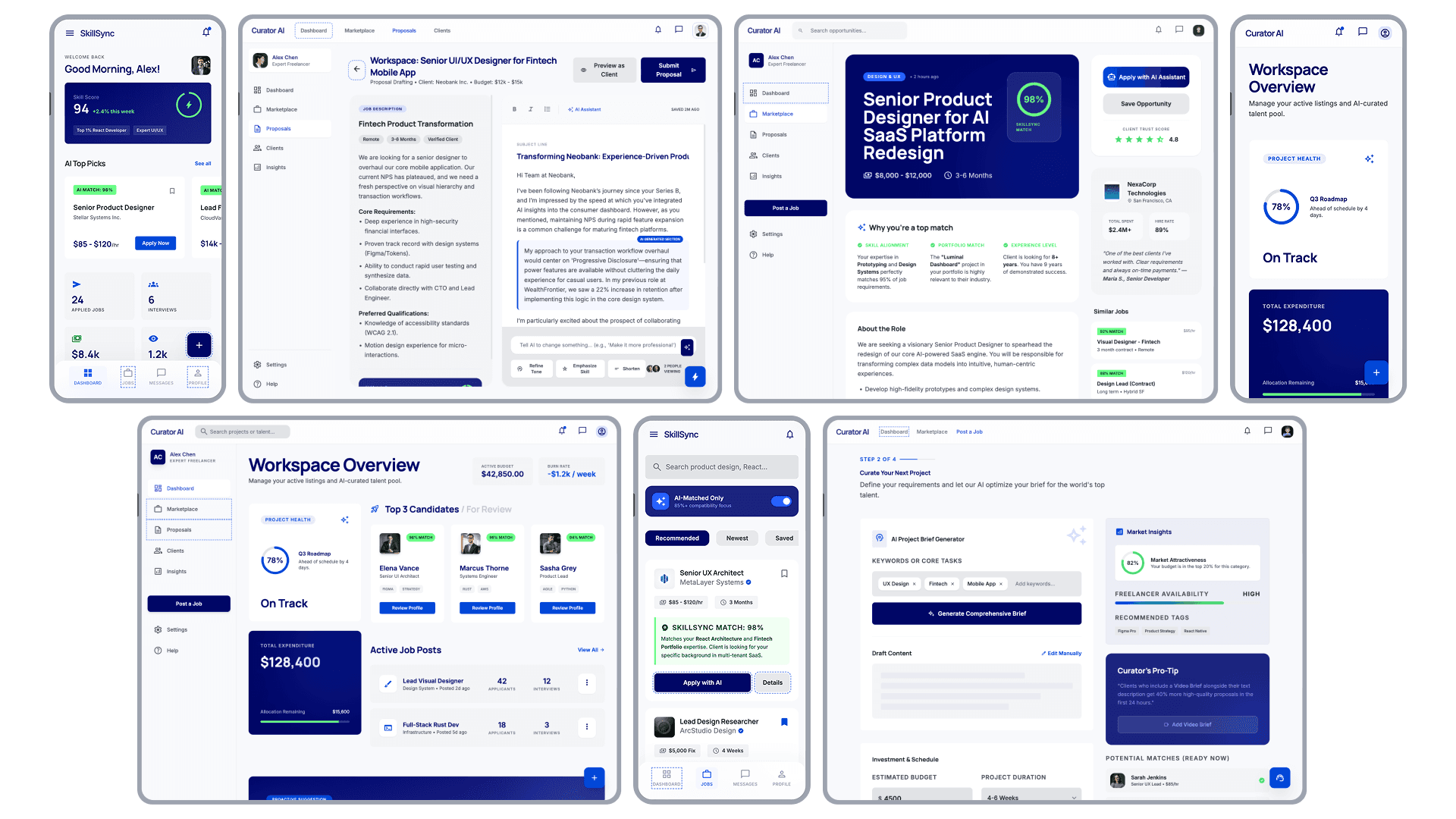
Four screens that show how the system works in real time.

Process
Five steps from problem to finished design
The work moved fast. Each phase built on the last. ChatGPT handled logic. Stitch AI generated UI. Figma refined everything.
Explore
Next
Week one
Problem and research
Identified the core friction. Clients get too many bad matches. Freelancers waste time on proposals. Both lose.
Explore
Next
Week one
Business thinking
Built the business model canvas. Two-sided platform. Revenue from commission, subscriptions, and ads. Value is reducing effort on both sides.
Explore
Next
Week two
AI ideation
Mapped where AI could solve each problem. Matching. Proposals. Pricing. Decisions. AI became the core, not an add-on.
Explore
Next

Week three
UI generation
Stitch AI generated screens based on the logic. Dashboards, job listings, proposal tools, candidate ranking. Raw but directional.
Explore
Next
Feature Section
Key Learnings—insights on product thinking, AI assistance, and platform dynamics.
Feature Section
Future Scope—list of next steps, including prototype, AI integration, payment system, and live demo with an “evolving product” highlight.

Reflection
From assignment to product
This started as a classroom exercise. Most students filled in a canvas and moved on. I asked what if it was real. That question changed everything.
A business model became a platform concept.
A platform concept became a UX system.
A UX system became a startup-level idea.
Read
Next
Let's build AI-driven products together
The best ideas come when small tasks are taken seriously.
Resume
Contact
Questions
Common questions about SkillSync, the design process, and how AI changes hiring.
Why AI matching?
Traditional hiring relies on keywords and luck. AI matching reads the full picture—skills, experience, work style, availability. It finds real fits, not just resume matches. The result is fewer bad hires and faster decisions.
How long did this take?
Three to four weeks from problem to finished design. Week one covered research and business strategy. Weeks two and three focused on AI logic and UI generation. Speed came from clarity on what the product actually needed to do.
Can freelancers edit proposals?
Yes. The AI generates a strong starting point, but freelancers can refine it before sending. The system saves time on the blank page problem while keeping human judgment in the loop.
How does pricing work?
SkillSync suggests rates based on skill level, project complexity, and market data. Freelancers can accept or adjust. Clients see the reasoning behind each rate, which builds trust and reduces negotiation friction.
Is this live yet?
Not yet. This is a design concept and UX system. The next phase is building an interactive prototype and connecting real AI APIs. The live demo will let you test matching and proposal generation yourself.
Contact Now
Want to collaborate?
Reach out if you're interested in building this or exploring similar AI products.
SkillSync — AI-powered freelance matching platform
Designing a smarter way to connect freelancers and clients using AI-driven matching, proposal generation, and decision support. Better matches. Less effort. Lower risk.
View case study
Live prototype
Snapshot
The work at a glance
Product designer leading the full concept
Role
Product designer
View
Timeline
Three to four weeks of design work
View
Tools
ChatGPT, Stitch AI, and Figma
View
Type
AI marketplace SaaS platform
View
Origin
How a classroom exercise became real
This started as a business model canvas assignment. Most students treated it as theory. I asked a different question instead.
What if this became an actual product?
That question changed everything.
SkillSync was born from that curiosity.
Read
Next
Problem
Hiring is broken and noisy
Clients drown in irrelevant applications. Freelancers waste time writing identical proposals. Both sides lose.
Explore
Next
Feature Section
Solution breakdown: SkillSync as “Upwork + AI Recruiter” with bullet points on AI matching, proposal generation, pricing, and hiring acceleration.
Feature Section
Business Thinking—visual Business Model Canvas and Value Proposition Canvas, with insights on platform model, revenue, and value creation.
Feature Section
Product Architecture—diagram or illustration of the 3-layer system: Input (profiles/jobs), AI (matching/proposals/pricing), Output (matches/decisions).
Features
What makes it work
Six tools built for speed and accuracy.
AI matching engine
Finds the best fit instantly.
View
Proposal generator
Writes pitches that actually convert.
View
Pricing suggestions
Sets rates that win without leaving money.
View
Smart dashboard
Shows what matters most at a glance.
View
Feature Section
User Flows for freelancers and clients, depicted with visual journey maps or step-by-step diagrams.
Feature Section
AI Layer—explaining how AI is embedded throughout the product, emphasizing “AI is not a feature — it is the product.”
Design
Four screens that show how the system works in real time.
Process
Five steps from problem to finished design
The work moved fast. Each phase built on the last. ChatGPT handled logic. Stitch AI generated UI. Figma refined everything.
Explore
Next
Week one
Problem and research
Identified the core friction. Clients get too many bad matches. Freelancers waste time on proposals. Both lose.
Explore
Next
Week one
Business thinking
Built the business model canvas. Two-sided platform. Revenue from commission, subscriptions, and ads. Value is reducing effort on both sides.
Explore
Next
Week two
AI ideation
Mapped where AI could solve each problem. Matching. Proposals. Pricing. Decisions. AI became the core, not an add-on.
Explore
Next
Week three
UI generation
Stitch AI generated screens based on the logic. Dashboards, job listings, proposal tools, candidate ranking. Raw but directional.
Explore
Next
Feature Section
Key Learnings—insights on product thinking, AI assistance, and platform dynamics.
Feature Section
Future Scope—list of next steps, including prototype, AI integration, payment system, and live demo with an “evolving product” highlight.
Reflection
From assignment to product
This started as a classroom exercise. Most students filled in a canvas and moved on. I asked what if it was real. That question changed everything.
A business model became a platform concept.
A platform concept became a UX system.
A UX system became a startup-level idea.
Read
Next
Let's build AI-driven products together
The best ideas come when small tasks are taken seriously.
Resume
Contact
Questions
Common questions about SkillSync, the design process, and how AI changes hiring.
Why AI matching?
Traditional hiring relies on keywords and luck. AI matching reads the full picture—skills, experience, work style, availability. It finds real fits, not just resume matches. The result is fewer bad hires and faster decisions.
How long did this take?
Three to four weeks from problem to finished design. Week one covered research and business strategy. Weeks two and three focused on AI logic and UI generation. Speed came from clarity on what the product actually needed to do.
Can freelancers edit proposals?
Yes. The AI generates a strong starting point, but freelancers can refine it before sending. The system saves time on the blank page problem while keeping human judgment in the loop.
How does pricing work?
SkillSync suggests rates based on skill level, project complexity, and market data. Freelancers can accept or adjust. Clients see the reasoning behind each rate, which builds trust and reduces negotiation friction.
Is this live yet?
Not yet. This is a design concept and UX system. The next phase is building an interactive prototype and connecting real AI APIs. The live demo will let you test matching and proposal generation yourself.
Contact Now
Want to collaborate?
Reach out if you're interested in building this or exploring similar AI products.
SkillSync — AI-powered freelance matching platform
Designing a smarter way to connect freelancers and clients using AI-driven matching, proposal generation, and decision support. Better matches. Less effort. Lower risk.
View case study
Live prototype
Snapshot
The work at a glance
Product designer leading the full concept
Role
Product designer
View
Timeline
Three to four weeks of design work
View
Tools
ChatGPT, Stitch AI, and Figma
View
Type
AI marketplace SaaS platform
View
Origin
How a classroom exercise became real
This started as a business model canvas assignment. Most students treated it as theory. I asked a different question instead.
What if this became an actual product?
That question changed everything.
SkillSync was born from that curiosity.
Read
Next
Problem
Hiring is broken and noisy
Clients drown in irrelevant applications. Freelancers waste time writing identical proposals. Both sides lose.
Explore
Next
Feature Section
Solution breakdown: SkillSync as “Upwork + AI Recruiter” with bullet points on AI matching, proposal generation, pricing, and hiring acceleration.
Feature Section
Business Thinking—visual Business Model Canvas and Value Proposition Canvas, with insights on platform model, revenue, and value creation.
Feature Section
Product Architecture—diagram or illustration of the 3-layer system: Input (profiles/jobs), AI (matching/proposals/pricing), Output (matches/decisions).
Features
What makes it work
Six tools built for speed and accuracy.
AI matching engine
Finds the best fit instantly.
View
Proposal generator
Writes pitches that actually convert.
View
Pricing suggestions
Sets rates that win without leaving money.
View
Smart dashboard
Shows what matters most at a glance.
View
Feature Section
User Flows for freelancers and clients, depicted with visual journey maps or step-by-step diagrams.
Feature Section
AI Layer—explaining how AI is embedded throughout the product, emphasizing “AI is not a feature — it is the product.”
Design
Four screens that show how the system works in real time.
Process
Five steps from problem to finished design
The work moved fast. Each phase built on the last. ChatGPT handled logic. Stitch AI generated UI. Figma refined everything.
Explore
Next
Week one
Problem and research
Identified the core friction. Clients get too many bad matches. Freelancers waste time on proposals. Both lose.
Explore
Next
Week one
Business thinking
Built the business model canvas. Two-sided platform. Revenue from commission, subscriptions, and ads. Value is reducing effort on both sides.
Explore
Next
Week two
AI ideation
Mapped where AI could solve each problem. Matching. Proposals. Pricing. Decisions. AI became the core, not an add-on.
Explore
Next
Week three
UI generation
Stitch AI generated screens based on the logic. Dashboards, job listings, proposal tools, candidate ranking. Raw but directional.
Explore
Next
Feature Section
Key Learnings—insights on product thinking, AI assistance, and platform dynamics.
Feature Section
Future Scope—list of next steps, including prototype, AI integration, payment system, and live demo with an “evolving product” highlight.
Reflection
From assignment to product
This started as a classroom exercise. Most students filled in a canvas and moved on. I asked what if it was real. That question changed everything.
A business model became a platform concept.
A platform concept became a UX system.
A UX system became a startup-level idea.
Read
Next
Let's build AI-driven products together
The best ideas come when small tasks are taken seriously.
Resume
Contact
Questions
Common questions about SkillSync, the design process, and how AI changes hiring.
Why AI matching?
Traditional hiring relies on keywords and luck. AI matching reads the full picture—skills, experience, work style, availability. It finds real fits, not just resume matches. The result is fewer bad hires and faster decisions.
How long did this take?
Three to four weeks from problem to finished design. Week one covered research and business strategy. Weeks two and three focused on AI logic and UI generation. Speed came from clarity on what the product actually needed to do.
Can freelancers edit proposals?
Yes. The AI generates a strong starting point, but freelancers can refine it before sending. The system saves time on the blank page problem while keeping human judgment in the loop.
How does pricing work?
SkillSync suggests rates based on skill level, project complexity, and market data. Freelancers can accept or adjust. Clients see the reasoning behind each rate, which builds trust and reduces negotiation friction.
Is this live yet?
Not yet. This is a design concept and UX system. The next phase is building an interactive prototype and connecting real AI APIs. The live demo will let you test matching and proposal generation yourself.
Contact Now
Want to collaborate?
Reach out if you're interested in building this or exploring similar AI products.